
Black Duck and Ring-necked Duck Populations Remain Strong in Eastern Survey Area
Mallards decrease slightly, stand 23% below the long-term average
Since 1990, the Eastern Survey Area has cataloged breeding ducks across 0.7 million square miles that span parts of Ontario, Quebec, Newfoundland and Labrador, Nova Scotia, Prince Edward Island, New Brunswick, New York, and Maine.
The U.S. Fish and Wildlife Service, the Canadian Wildlife Service, and Flyway Council partners survey the ESA each spring to provide breeding estimates for the most abundant species of breeding ducks — mallards, black ducks, green-winged teal, ring-necked ducks, goldeneye, and mergansers — in the eastern United States and Canada.
The ESA data provides season frameworks and bag limits for the Atlantic Flyway using a multi-stock model based on green-winged teal, ring-necked duck, goldeneye, and wood duck populations.
In accordance with the 2025 survey, U.S. hunters in the Atlantic Flyway will enjoy a liberal 60-day season and six-duck limit. Canadian seasons and limits vary by province. The estimates from this year’s survey likely mean similar guidelines will remain in place for the 2027-2028 season.
Eastern mallard populations dipped this spring, falling from 908,000 in 2025 to 890,000, a 2% decrease and 23% below the long-term average. It’s been estimated that only 15% of harvested Atlantic Flyway mallards come from the prairie pothole region. It’s pivotal that eastern mallard numbers remain healthy so hunters can continue to shoot a four-bird limit with a maximum of two hens. Recent research revealed that less than 30% of the flyway’s mallards are truly wild due to the widespread release of game-farm birds in the mid-20th century. The effect (if any) on populations is still unknown, but game-farm genetics coupled with hybridization with black ducks may be negatively affecting eastern mallards.
Black ducks declined by 6%, dropping from 786,000 to 739,000, but remain 6% above the LTA. The species was once the most abundant dabbler in eastern North America, but coastal urbanization (black ducks rely heavily on salt marshes for survival during the migration) has fractured wintering habitat. Fortunately, the population has stabilized from an all-time low in the 1980s.
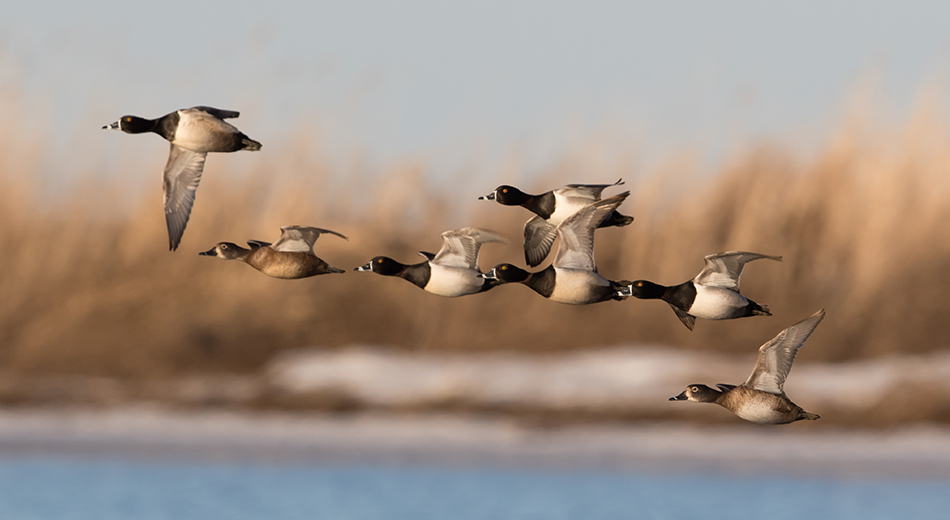
Ring-necked ducks, the most harvested diver in the flyway, are trending the right way, jumping from 759,000 to 829,000, a 9% bump from 2025 and 16% above the LTA. That’s a boon for southern hunters in Georgia, Florida and the Carolinas, where 80% of the flyway’s ringnecks historically winter.
Green-winged teal were down 6% from 2025. There were 320,000 breeding greenwings in the ESA, 12% below the LTA. Goldeneye were 7% down with no change over the LTA. Mergansers are up 6% from last year and 2% above the LTA.
Wood duck populations are estimated using Atlantic Flyway Breeding Waterfowl Survey data for northeast states from New Hampshire south to Virginia in conjunction with the Breeding Bird Survey, a series of roadside observations from specified routes that has existed for decades. The 2026 estimate of wood ducks in the Atlantic Flyway was 900,000, similar to the long-term average.
Eastern Canada, the Maritimes, and the northeastern U.S. had an average winter with average to below-average precipitation, particularly in southern Quebec and to the east. Average to above-average spring precipitation improved wetland conditions, but cooler spring temperatures slightly delayed spring migration. — Joe Genzel